Meta Ads CAC: How to Calculate It and Scale Profitably
Customer Acquisition Cost (CAC) in Meta Ads: How to Calculate It and Know When to Scale
By Clarence Gil | The Meta-matician | Digital Homie
Before you spend another ₱50,000 on Meta Ads, ask yourself one question: How much can your business afford to spend to acquire one paying customer?
If you don't know the answer, you're making advertising decisions without one of the most important numbers in your business.
You might have a high click-through rate. Your cost per lead might look impressive. Your ads might even be generating hundreds of inquiries.
But none of those numbers automatically means your business is making money.
The real question isn't how many leads your ads generate. It's how much you spend to acquire a customer and whether that customer is profitable.
This is where Customer Acquisition Cost, or CAC, becomes essential.
In this guide, I'll explain how to calculate CAC, determine what your business can afford, and use that number to make smarter decisions about your Meta Ads campaigns.
What Is Customer Acquisition Cost (CAC) in Meta Ads?
Customer Acquisition Cost (CAC) is the average amount of money your business spends to acquire one new paying customer.
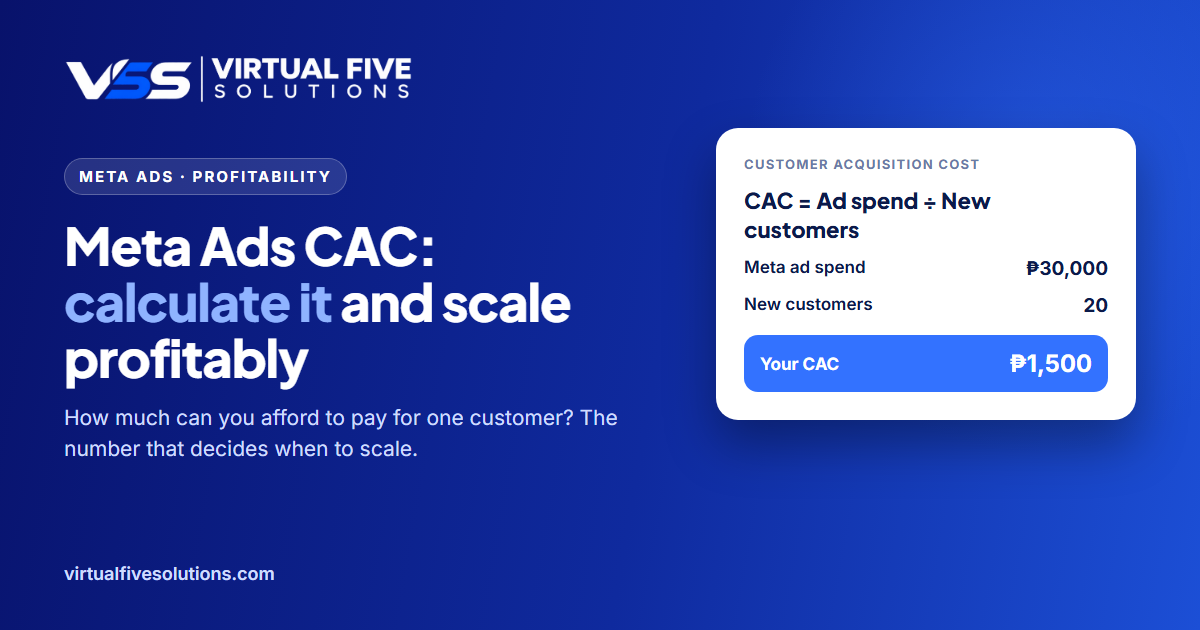
For Meta Ads, you can calculate an advertising-only CAC by dividing your advertising spend by the number of new customers acquired through those ads.
Meta Ads CAC = Meta Ads Spend ÷ New Customers Acquired
For example:
You spend ₱30,000 on Facebook and Instagram advertising and acquire 20 new paying customers.
Your advertising CAC is:
₱30,000 ÷ 20 = ₱1,500 per customer.
That means you spent an average of ₱1,500 in advertising to acquire each customer.
But is ₱1,500 expensive?
Is it cheap?
Should you increase your budget?
The answer depends on your business economics.
A ₱1,500 CAC might be profitable for a company selling a ₱10,000 service. It could be disastrous for a company selling a ₱999 product with a thin profit margin.
There is no universally good CAC. There is only a CAC your business can or cannot afford.
One important distinction: advertising CAC counts advertising costs only. Your fully loaded CAC may also include sales salaries, agency fees, marketing software, creative production, and other acquisition expenses.
Both are useful, but they answer different financial questions.
Why CAC Matters More Than Cheap Leads
One of the biggest mistakes I see business owners make is celebrating cheap leads without understanding how many of those leads become customers.
Let's compare two hypothetical campaigns.
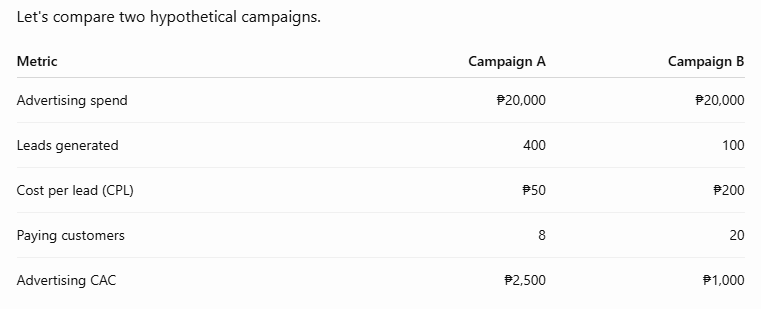
At first glance, Campaign A looks better because its cost per lead is only ₱50.
Campaign B costs four times more per lead.
But Campaign B generates more than twice as many paying customers from the same budget.
Campaign B has a lower CAC even though it has a higher CPL.
This is why I always encourage business owners to look beyond Ads Manager.
A cheap lead isn't necessarily a valuable lead.
And a campaign that generates expensive leads isn't automatically a bad campaign.
What matters is whether those leads turn into profitable customers.
CAC vs. CPL vs. CPM: Understanding the Difference
Three metrics help explain how your Meta Ads campaigns perform at different stages.
1. CPM: Cost Per 1,000 Impressions
CPM measures the average cost of delivering 1,000 ad impressions.
It tells you about the cost of advertising exposure, not the cost of acquiring a customer.
2. CPL: Cost Per Lead
CPL measures the average advertising cost of generating one lead.
CPL = Advertising Spend ÷ Leads Generated
This helps you evaluate how efficiently your campaigns generate inquiries, registrations, or contact information.
3. CAC: Customer Acquisition Cost
CAC measures how much you spend to acquire an actual paying customer.
Advertising CAC = Advertising Spend ÷ New Paying Customers
These metrics are connected, but they are not interchangeable.
A low CPM doesn't guarantee cheap leads.
A low CPL doesn't guarantee paying customers.
And a low advertising CAC doesn't automatically mean your business is profitable.
You still need to understand your margins and other operating costs.
CPM tells you what exposure costs. CPL tells you what leads cost. CAC tells you what customer acquisition costs.
For business owners, CAC brings the discussion closer to the actual financial outcome.
How to Calculate Your Ideal CAC Before Running Meta Ads
Before launching or scaling a campaign, determine how much your business can reasonably afford to pay for a customer.
Let's use a hypothetical Philippine e-commerce business.
Assume you're selling a product for ₱2,500.
Your costs per order are:
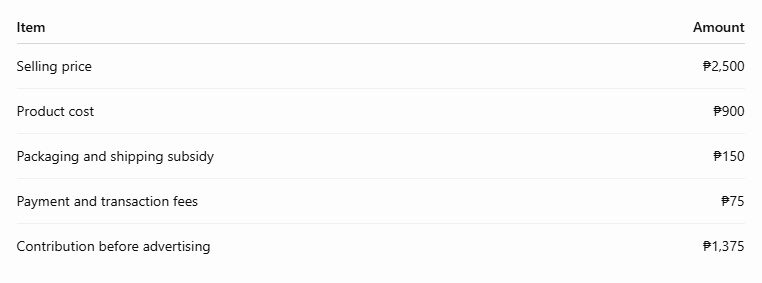
This leaves ₱1,375 per order before advertising, fixed overhead, and other costs not included in the example.
Your first-order break-even advertising CAC would be approximately ₱1,375 if all relevant variable costs have been accounted for.
But here's the mistake you should avoid:
Your break-even CAC should not automatically become your target CAC.
If you spend the entire ₱1,375 acquiring a customer, there's no contribution left from that first order to cover additional expenses or generate operating profit.
Suppose you want to retain ₱500 per first order after advertising.
Your target advertising CAC becomes:
₱1,375 − ₱500 = ₱875
You now have a clearer framework:
Target CAC: ₱875
First-order break-even advertising CAC: ₱1,375
CAC above ₱1,375: first-order contribution loss, assuming the same economics
These are planning thresholds, not universal Meta Ads benchmarks.
Your actual limits should account for refunds, returns, discounts, taxes where relevant, repeat purchases, cash flow, and operating expenses.
How to Use CAC to Decide Whether to Scale Your Meta Ads
This is where CAC becomes more than a reporting metric.
It becomes a decision-making tool.
Imagine your target advertising CAC is ₱875.
After running your campaigns, you see these results:
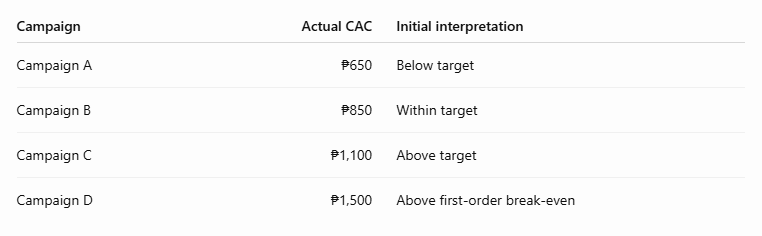
Should you scale Campaign A?
Should you pause Campaign D?
Not immediately.
CAC provides a financial reference point, but you also need to consider conversion volume, tracking accuracy, customer quality, margins, and how stable the results are.
Here's the decision framework I recommend.
Decision 1: Scale When the Economics and Evidence Support It
If a campaign consistently acquires customers below your target CAC and produces sufficient conversion volume, it may be a candidate for controlled budget increases.
But remember: increasing the budget can change performance.
A campaign producing a ₱650 CAC at ₱1,000 per day won't necessarily maintain that CAC at ₱10,000 per day.
Scale gradually, monitor marginal acquisition costs, and compare results against your financial targets.
Scaling is not a feeling. It's a calculation supported by evidence.
Decision 2: Optimize When CAC Is Above Target
Suppose your actual CAC is ₱1,100, while your target is ₱875.
Don't immediately assume the creative is the problem.
Investigate the customer journey.
Are your ads attracting the right audience?
Does your landing page clearly explain the offer?
Are leads receiving timely follow-ups?
Are customers abandoning checkout?
Is your sales team converting qualified inquiries?
Sometimes the biggest opportunity isn't inside Ads Manager.
It's in the process that happens after someone clicks your ad.
Decision 3: Reduce or Stop Spending When Losses Are Unsustainable
If a campaign repeatedly acquires customers above your economically sustainable CAC, you need to reconsider the investment.
That could mean reducing spend, testing a different offer, improving conversion rates, or pausing the campaign.
However, avoid making decisions based on one expensive customer or a very small sample.
Evaluate performance over an appropriate period, allowing for normal sales delays and attribution limitations.
The goal is to avoid both unnecessary losses and premature decisions.
The Missing Connection: Your Sales Funnel Affects CAC
Here's something business owners often overlook.
Your Meta Ads performance and your sales conversion process are financially connected.
Imagine spending ₱20,000 to generate 200 leads.
Your CPL is ₱100.
If your sales team converts 5% of those leads, you acquire 10 customers.
Your advertising CAC is ₱2,000.
Now suppose you improve your follow-up process and increase your lead-to-customer conversion rate to 10%, without increasing advertising spend.
You acquire 20 customers.
Your advertising CAC drops to ₱1,000.
Same advertising spend.
Same number of leads.
Twice as many customers.
You reduced CAC by improving conversion, not by buying cheaper traffic.
This is why business owners should examine both sides of customer acquisition:
Traffic → Leads → Follow-Up → Paying Customers
When one part of that process is weak, your entire acquisition economics can suffer.
Why Meta Ads Reports Alone May Not Show Your True CAC
Meta Ads Manager is useful, but its reported conversions don't always equal the number of unique new customers your business actually acquired.
Meta reports results according to campaign objectives, available tracking signals, and attribution settings.
Your business records may tell a different story.
For example, a customer might interact with multiple ads before purchasing, buy through another channel, or make a repeat purchase that appears in advertising reports.
This creates a risk of confusing reported purchases with genuinely new customers.
For a more reliable CAC analysis, combine:
Meta Ads spend and performance reports.
Website, checkout, or payment records.
CRM and sales data identifying new customers.
A consistent attribution method and reporting period.
For businesses with longer sales cycles, consider how much time typically passes between the first inquiry and the final sale.
A campaign may generate leads today but acquire paying customers several weeks later.
The purpose of tracking is not to make your dashboard look impressive. It's to make better financial decisions.
How Customer Lifetime Value Changes Your CAC Strategy
Not every business needs to recover its full acquisition cost from the first transaction.
This is where Customer Lifetime Value, or LTV, becomes relevant.
Consider two businesses.
Business A sells a one-time product with limited repeat purchasing.
Business B sells a monthly subscription with customers who often remain subscribed for several months.
Business B may be able to justify a higher initial CAC because customers can generate additional contribution over time.
But that doesn't mean subscription businesses should spend unlimited amounts acquiring customers.
You still need to understand retention, gross margin, cash flow, churn, and CAC payback period.
For example, if a customer generates ₱500 in monthly contribution after variable service costs and your CAC is ₱1,500, the simple contribution-based payback period is three months, assuming that contribution remains stable.
Whether three months is acceptable depends on your business model and financial position.
Your ideal CAC should reflect how your business actually makes money, not somebody else's advertising benchmark.
The Meta-matician CAC Decision Framework
When reviewing a Meta Ads campaign, I recommend answering five questions.
1. What is my target CAC?
Determine how much you can afford to spend based on your margins and business goals.
2. What is my actual CAC?
Calculate your advertising spend against verified new customers, not just leads or clicks.
3. Is the campaign generating enough data?
Avoid drawing strong conclusions from a handful of conversions.
4. Where is the biggest bottleneck?
Identify whether the main opportunity is in traffic quality, creative messaging, the offer, landing page, follow-up, or sales conversion.
5. What is the next financially sensible decision?
Decide whether to scale, optimize, hold, reduce spend, or stop.
You don't need to become an expert in every Ads Manager feature to understand these questions.
But as a business owner, you should understand the economics behind your marketing investment.
Because knowing how to launch a campaign is different from knowing whether that campaign is worth scaling.
Final Thoughts: Never Scale What You Don't Understand
Before increasing your Meta Ads budget, understand how much you're spending to acquire a customer.
Know your target CAC.
Know your actual CAC.
Understand your margins.
And investigate what happens between an ad click and a paying customer.
The goal isn't to generate the cheapest leads. The goal is to acquire customers at a cost your business can sustainably afford.
When you understand those numbers, you can make advertising decisions with more clarity and less guesswork.
And that's how Meta Ads starts becoming a business investment rather than an expensive experiment.
Need Help Understanding Your Meta Ads Numbers?
If you've already spent thousands on Meta Ads but still don't know what to fix, optimize, or scale.